Scroll through excerpts from Jon's field journal below, or download .pdf to read later. Either way, these field updates give you an idea of the challeneges and rewards of the conservation work we do.
Summary of the 2007 Fish Owl Field Season
Update 1: Early February 2007
Since my arrival in Primorye I have been working with Sergei Surmach’s team of fish owl field assistants, with our work concentrated near Olga, a coastal village several hundred kilometers northeast of Vladivostok. We have been living in a GAZ-66 (Fig.1), a durable truck with a living compartment on the bed, complete with a wood-burning stove. As nights have been dipping to -20ºC, it’s nice that there is a warmer alternative than sleeping in a tent.
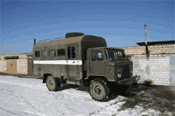
Fig. 1. GAZ-66, the vehicle that we have been using to transport and house us while working near Olga. Picture taken 09 February 2007, near Arsenyev.
The first week of the 2007 field season has been one of mixed success. The goal of this first week was to (a) resight two fish owl pairs discovered last year near Olga, and (b) to locate hunting areas of these pairs that would make appropriate capture sites.
The first pair, which has a territory along the Avvakumovka River near the Mineralnaya River, was quickly resighted at a roost in the same general area we found them last year (Fig. 2). The mild winter has resulted in much more open water than usual. We discovered numerous hunting sites along a 1 km stretch of the Avvakumovka River and sections of the Mineralnaya River. This large hunting area will complicate captures, but with patience and time I am sure our attempts will be successful.
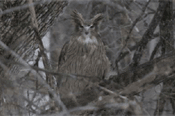
Fig. 2. One of the Mineralnaya pair at a well-used roost. Both birds were here and allowed me to approach within 50m before flushing a short distance. Picture taken 11 February, 2007.
The situation with the second pair, near the village of Vetka, is much different. After numerous attempts we have only been able to relocate the adult male, and have found no evidence of the adult female or the juvenile that successfully fledged last year (see Photos 2006 for images of these birds). We believe that both of these owls were killed (intentionally or otherwise) during the salmon run along the Sadoga River, which runs through this pair’s territory. There were so many salmon this year that the area was overrun with poachers catching salmon and armed inspectors catching poachers. Between all the nets in the rivers and the rifles in hand during this time that we believe these two birds either became entangled and drowned or were shot. The male calls alone from areas where the pair successfully nested in past years. Along with being unable to resight the adult female and last year’s juvenile, we have also been unable to find where the lone fish owl hunts. Like the Mineralnaya pair, there is much open water where the bird could potentially be hunting. However, whereas at Mineralnaya we were able to scan the snowy river banks for distinctive fish owl tracks, at Vetka this is not the case. With the abundant salmon runs came hoards of white-tailed and Stellar’s sea eagles (Fig. 3), many of which have over-wintered in the region, and continue to forage on the thousands of salmon carcasses that litter the riverbanks.
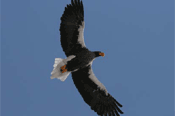
Fig. 3. Stellar’s sea eagle soaring above the Sadoga River near Vetka, Primorye. Hunderds of eagles have overwintered in the region to feed on salmon carcasses. Picture taken 12 February, 2007.
The air along the Sadoga River is heavy with the stench of rotting salmon and eagle excrement. There are so many dead salmon that they even hang from trees (Fig. 4). Furthermore, nearly every potential fish owl hunting area is completely overrun with eagle tracks, making it impossible for us to identify where the fish owl hunts, which is critical for capture.
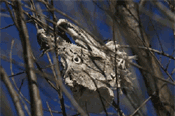
Fig. 4. Salmon head hanging from a tree, not an uncommon sight along the Sadoga River this winter. Picture taken 12 February, 2007.
Aside from the lone male calling, we have found no other evidence of fish owl presence: no tracks, no feathers. Given the extremely elusive nature of these owls, this lack of sign may be an indication that the adult female and juvenile are present yet remain undetected. Throughout this field season and continuing on through the year we will continue to survey the Vetka territory for the missing birds and hunting areas.
Update 2
We arrived in Ternei late on February 12th, and found fresh fish owl tracks almost immediately the next day. The situation in Ternei is much different than in Olga; here most waterways are frozen, and the fish owl pair that lives on the Serebryanka River near the village of Artyomovo (10 km north of Ternei) islimited to only a handful of open water areas. Several of these are littered with fish owl tracks, and represent excellent opportunities for capture.
We returned to Ternei and began constructing noose carpets using hardware cloth and monofilament nylon fishing line, and then the snow began falling. For two days Ternei was at the center of a battle between wind and snow, and in the end nearly two feet of snow accumulated. At the Wildlife Conservation Society office, which is perched on a hill overlooking Ternei and the Sea of Japan and where the team is staying, the snow drifted above waist height (Fig. 5). As capture is not possible in this weather, we stayed in Ternei.
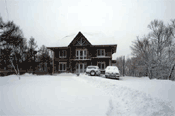
Fig. 5. WCS office in Ternei during snow storm, 15 February 2007.
Sergei Surmach had intended to join us in Ternei on February 15th, but the snow in Vladivostok was even worse. There, whiteout conditions and chaos summed up the worst winter storm the city has seen in recent memory. All traffic in and out of the city was paralyzed for two full days. On February 16th we returned to the hunting sites found before the snowfall and were dismayed to see that they had not been used. Perhaps the deep snow made landing on the bank inconvenient for the owls, and perhaps they had moved on to another part of their territory. To find out, we decided to employ an old Udege trick.
On February 17th Sergei Avedyuk and I returned to these sites and strategically placed five stumps in three different foraging areas, so that the owls would have a solid place to land (Fig. 6). We covered stump surfaces with a thin layer of snow, which would betray the presence of anything that landed there. When we checked these stumps on the morning of February 18th, we were excited to see fish owl tracks on four of the five stumps.
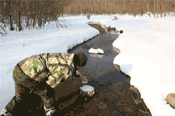
Fig. 6. Sergei Avdeyuk sprinkles a layer of snow on a stump allowing fish owls easier access to hunting sites. Within hours a fish owl had landed on this stump. WCS biologist Dale Miquelle looks on from the distance.
On February 20th we placed snares on stumps and on river banks where the owls have landed in the past. By Feburary 24th we have had one nearmiss, as a fish owl landed on a snared stump but was able to free itself before we arrived. Nights have been long and cold; I check the tripped snare beacons (using a VHF receiver) every 30 minutes from 7pm to 7am from a tent 150-250 m away from all snares.
Temperatures have dipped to -30ºC (Fig. 7). Fish owls have been visiting these foraging areas but, aside from the one near miss, have not landed on any of our noose carpets. The snow is now hard, and it is difficult to conceal the wire mesh of the noose carpets and our tracks; the owls appear to be avoiding areas where we walk. Meanwhile, we have placed a few stumps at foraging areas along the Faata River, where we discovered an active fish owl territory some 12 km north of the Serebryanka pair that we are now targeting. We are working under the assumption that the Faata pair will become accustomed to the stumps and we will be able to catch them quickly. Hopefully we will have some success soon, because I am in bad need of a bath and a good night’s sleep!
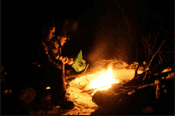
Fig. 7. Awaiting capture: Sergei and I warm ourselves by the fire before retreating to the wind-free sanctuary of our tent.
Update 3
I certainly thought by Update #3 I’d have a capture to report, but that is not the case. Sergei and I have been focusing on a pair of owls on the Faata River, about 20 km north of Ternei. We have been staying in a cabin there which used to be part of a hydro-electric station, and powered Ternei during the Second World War (Fig. 8). Apparently the station was operational until the early 1990s, after which its demise must have been sudden and terrible, because little of it remains. We came across this cabin while searching for fish owl tracks and Anatoli, who lives there, invited us to stay with him while we work in the area.
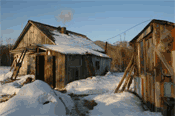
Fig. 8. Anatoli’s cabin on the Tunsha River, not far from the confluence with the Faata River where our target owls hunt. We have been staying in this cabin for more than a week.
Anatoli is a sad man; at age 57, he has lived alone in the woods for 10 years, and is compelled to stay, he says, because of a 15th century Bohai-era temple he found on the peak of the closest mountain. He doesn’t know what the spirit of the mountain wants him to do, but it’s something connected to the temple. So he waits in the valley below, always within sight of the temple, for his life’s purpose to reveal itself.
Needless to day this is an issue that requires some delicacy; he is our host and is therefore worthy of our respect, but conversations about the temple (which, frankly, could be no more than a random pile of rocks) and energy and vibrations become tiring.
The cabin itself it a two-room structure that retains heat well. The decor is Spartan; aside from a few beds, a desk and a table there is no furniture, and there are only a few decorations on the walls: the first is a 2004 poster calendar depicting a pornographyreading monkey wearing sunglasses. The second, which hangs above my bed, is a painting of a young girl holding a cat and a bowl of milk (Fig. 9). For some reason she has cherries hanging from her hat. I don’t know what that girl is up to, but I am highly suspicious of her.

Fig. 9. The girl with cherries in her hat stares at me while I sleep.
The Faata fish owl pair hunts within several hundred meters of Anatoli’s cabin. We placed a number of snared stumps in locations we thought would be convenient for the fish owls, but apparently the fish owls think differently, because they have yet to trigger one of our traps.
At night I monitor our trap alarms, and during the day we search for additional hunting areas of not only the Faata pair, but of the Tunsha pair, whose territory borders the Faata pair to the south. We have been able to find the core of the Tunsha pair’s hunting area, and as of March 4th (my wife Karen’s birthday), we are officially trapping in two fish owl territories simultaneously. In addition to noosed stumps, we have also constructed box traps using fish as bait (Fig 10). It was with this method that Sergei successfully captured a fish owl in the Amur province. It doesn’t seem that a bird as cautious as a fish owl will fall for a trick as obvious as this one, but apparently they have in the past.
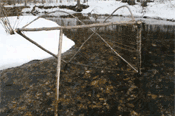
Fig. 10. This trap works when the lures (three fish) are disturbed, which causes the stick keeping the framed net upright to collapse, trapping the bird underneath.
We also recently discovered an additional fish owl just north of the Faata pair, but at this point it is unclear if that bird lives alone (and may be a dispersing juvenile), or is part of an established, resident pair.
On March 5th we came into Ternei to pick up some additional trap alarms and to banya, and we may be here for a day or two. The snow is coming down strong, and this storm is proving stronger than the one that halted our work in February. We closed down all of our traps before coming into town. Jus before leaving Anatoli’s on the morning of the 5th I took a photograph of a fish owl roost on the Tunsha River (Fig. 11).
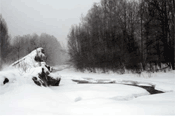
Fig. 11. This rocky outcropping along the mostly frozen Tunsha River serves as a roost for the resident fish owl pair. Picture taken 05 March 2007 during a snowstorm.
When we return we will set out an additional 6 traps (noose carpets and a dho-gaza); hopefully by saturating the area with traps we’ll finally get ourselves a fish owl and the telemetry project can finally begin. As of 06 March 2007 I have been in Russia for one month, and no captures to date is discouraging at best.
Update 4
There's a saying in Russia that I like: "the better your truck, the further you'll have to go for a tractor to pull you out". When we last left Ternei we did so in a hurry during a blizzard, and a tangible result of our haste was our stranded pickup truck 2 kilometers from the main road and 1.5 kilometers from where we are currently staying with Anatolii (see Update #3 for more on Anatolii). We have had several serious snowstorms thus far in March and the snow is now waist-deep in the woods, making any movement difficult (Fig. 12).
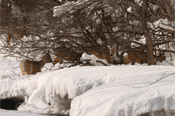
Fig. 12. These Roe deer have been having a tough time getting around in the meter-deep snow.
After several attempts to free the truck we were finally able to shovel our way back to the main road on March 17th; essentially we were stranded at Anatolii's for 12 days. Luckily we had a snowmobile so we could travel between fish owl territories easily in the deep snow.
I am happy to report that the nightmare that defined my life the past number of weeks ended with the capture of our first Blakiston's fish owl, the Faata male (Fig. 13).
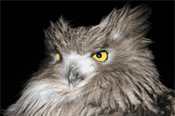
Fig. 13. The Faata male, just before his release
Since his capture and release the Faata male has duetted every night with his mate, and continues to roost during the day where he roosted prior to capture. These are good signs that the experience was not too traumatic for him.
The capture learning curve, I have discovered, is a cruel mistress. There are multiple nuances specific to each trap and capture site, and since late February we have had four fish owls escape our clutches largely due to our inexperience in trap placement and capture in general. The experience has been unpleasant. I need to capture four owls for this field season to be considered successful, but frankly learning how to safely catch owls and have a few to show for it is success enough for me.
The trap that we have found to work is a noose carpet used in conjunction with live fish bait. We constructed a shallow enclosure using hardware cloth (12x150x1000 cm) and placed it in shallow water within a fish owl's hunting territory (Fig. 14). We then filled it with as many live fish as we could catch, and placed noose carpets on nearby river banks. The Faata male found the enclosure on the second evening and ate half the fish before landing on a noose carpet. By 8:30 that evening we had the bird in hand.
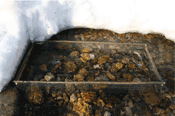
Fig. 14. This enclosure holds live fish and seems to be irresistible to fish owls.
The Faata pair are not nesting, meaning that the female is still available for capture, however we need to figure out how to set a trap specific to her. At this point we are not sure how to do that. The Tunsha pair, on the other hand, are nesting, meaning that at present only the male is available for capture as the female is on the nest full time. The Tunsha male cleaned out our fish enclosure two days in a row, but has not come back the past two nights (since we have laid noose carpets). So we wait. Hopefully he will be caught soon and we will then turn our efforts back to the Serebryanka pair.
Update 5
The capture floodgates have been released, and as though with wild-eyed fury Sergei and I swept across the Tunsha river valley capturing three additional owls in five nights. Although there is still some confusion about the sex and status of two birds captured on the Faata (we either have both the male and female, or the male and a young, dispersing adult), we now have what looks like individuals from three neighboring pairs. We have the Serebryanka male to the south, the Tunsha male some 7 km up river, and two birds further north in the Faata territory. Our sample size is now four birds.
The reason we are not clear about the situation on the Faata is that Blakiston’s fish owls are not easy to sex in the hand. The first bird we caught has been demonstrating behavior that indicates it may be a young adult (<2 years old) presently dispersing further north up the Faata from his natal territory where we caught him. We had found fish owl tracks along the bank of the Faata 6 km north of the resident pair, and we heard a lone bird calling there. We caught the young bird, however, in the heart of the Faata pair’s territory. Following capture and release, the bird roosted in the same vicinity of the Faata pair for two days before returning to the upper reaches of the Faata where we first detected him. However, this bird subsequently returned and is almost always in the same general area as the second Faata bird. Time will reveal the actual situation there.
Both the Tunsha male (Fig. 15) and the second Faata bird were captured using the same method we used to catch the first Faata bird, and both were caught during the hour following sunset.
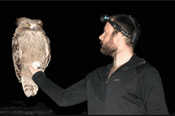
Fig. 15. The Tunsha male. According to the literature, male Blakiston’s fish owls are 75% the size of females, but we have yet to capture a female. This bird weighs 3.1 kg.
In anticipation of the third major snowstorm of the field season, we decided to pull out of the Tunsha region while we could. Even so, it took us nearly three hours and a lot of shoveling to drive the 2 km back to the main road. We re-focused our efforts on the Serebryanka pair, and set out an enclosure with fish. When we checked the enclosure on the next morning, most of the fish were gone, and fish owl tracks were all around on the bank. Therefore, we immediately set our snares.
After a few hours of unsuccessful fishing, we began turning over rocks in the river and found about a dozen frogs to put in the enclosure. Blakiston’s fish owls prey upon frogs almost exclusively in the spring, so we thought their inclusion as a live lure should be effective. At 19:45 the Serebryanka male tripped the trap but escaped; he returned and ate a few frogs before becoming entangled in our noose carpet on the bank around 22:30 (Figs. 16, 17).
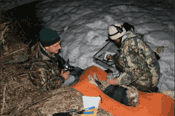
Fig. 16. Tiger biologist John Goodrich (WCS) looks on while Sergei takes measurements of the Serebryanka male.
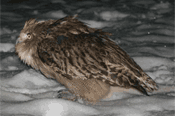
Fig. 17. Exhausted from the capture experience, the Serebryanka male pauses upon release before flying off.
With our fourth capture, the 2007
field season is officially a success.
There are no more fish owls that we are
aware of in the Ternei area to capture,
although we intend to survey river
bottoms adjacent to known territories for
additional pairs.
We are now taking a
short break, and possibly will not
capture any more birds this season as
everything is melting fast. If the warm
air holds the impending storm will not
be snow but rain, which will hasten
melting and everything will flood. In
that case we will start collecting data
from the road, and when the weather
allows we will begin searching for nest
trees of the Tunsha and Serebryanka pairs.
Update 6
Although we found one additional fish owl territory in the Ternei area, the opportunity to find fish owl hunting areas disappeared with the snow and rising spring water and there are no new bird captures to report. We were able to find a nest tree with one egg on the Tunsha, however a subsequent visit found the nest empty; no egg and no nestling. The Mineralnaya pair near Olga successfully hatched a single chick from two eggs, and that nest continues to be monitored.
Although I am back in Minnesota, Sergei Surmach and Sergei Avdeyuk will continue to search for new fish owl territories and try to capture the females at Tunsha and Serebryanka. New information, as available, will be presented on the www.fishowls.com website.